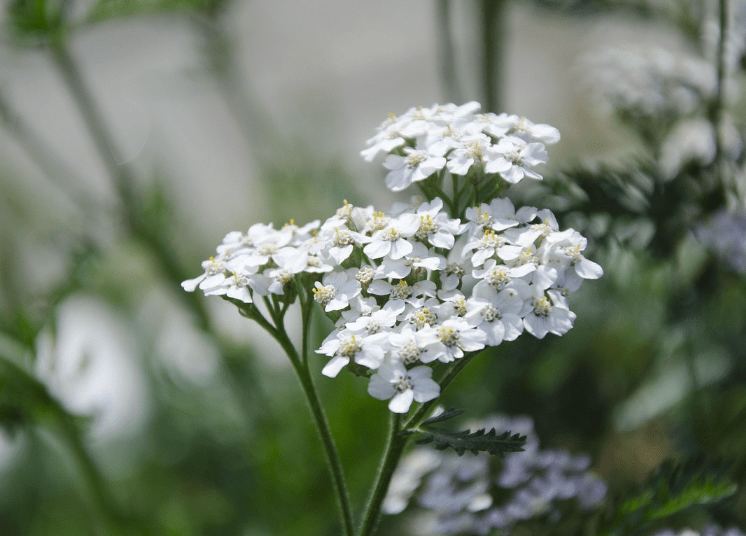
Originally called Herba militaris because of its medicinal uses on the battlefield, yarrow, Achillea millefolium, has been the subject of myths, legends, and folklore for centuries, as its chemical properties have long been misunderstood and its amazing healing virtues thought to be caused by otherworldly magic.
According to Greek mythology, Achilleas’s mother dipped him in a bath of yarrow tea, holding him by the heel, making him almost invincible. When the young man grew up and became a soldier, he carried the miraculous herb with him when he fought, using the plant to staunch the wounds of his compatriots. Yarrow was a said to have sprung from the rust on the warriors spear, and Chiron the centaur, the mystic wiseman of the heroes of old, taught Achilles how to use the herb. Many other Greek gods and goddesses are associated with yarrow, like Hermes and Aphrodite.
In Ireland, yarrow was hung over doors as a deterrent of evil spirits and worshiped by the ancient druid priests. The primitive islanders sang and prayed over the plant as they foraged for and collected yarrow
“I will pluck the yarrow fair
That more benign shall be my face,
That more warm shall be my lips,
That more chaste shall be my speech,
Be my speech the beams of the sun,
Be my lips the sap of the strawberry.
May I be an isle in the sea,
May I be a hill on the shore,
May I be a star in the waning of the moon,
May I be a staff to the weak,
Wound I can every man
Wound can no man me
– Carmichael
In medieval England, young girls used yarrow for love incantations, believing it could predict one’s future spouse. The dried stalks were used in China for primitive divination, as the herb was thought to awaken the spiritual forces of the mind, balancing yin and yang energy and bringing together heaven an earth. Fossilized yarrow has even been discovered in Iraq, buried in Neanderthal tombs, dating back to 60,000 years ago.
 Tyler Leatherman Portfolio
Leave a comment