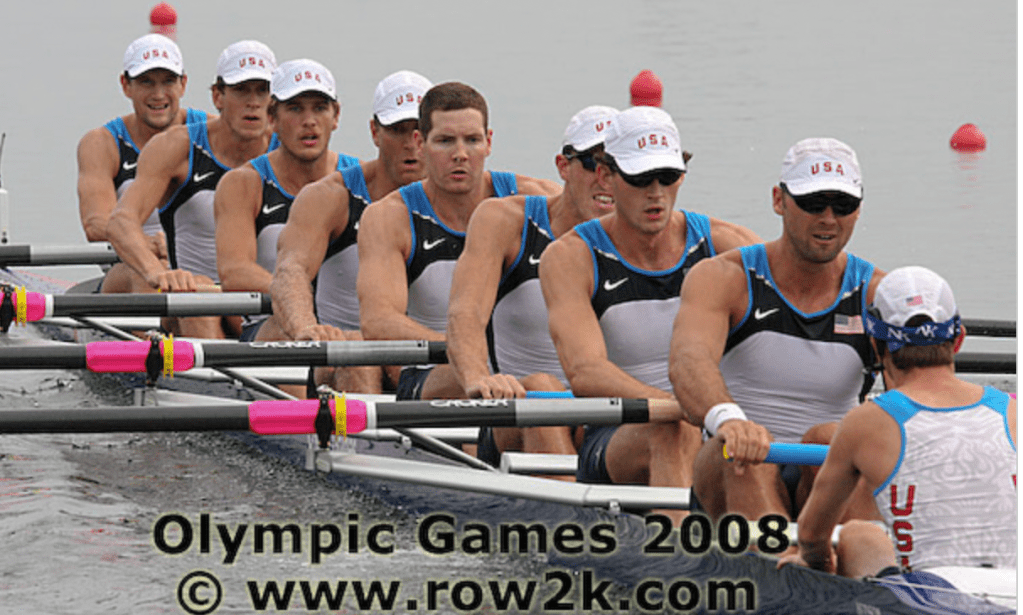
The road to the Olympics is anything but easy. Contenders train for years, with multiple practices per day and strict out-of-sport regimes to maintain peak condition. Commitment, dedication, and intrinsic motivation are essential qualifications needed to have the opportunity to represent your country at the international level.
Many of these athletes are recruited as teenagers to top-notch colleges and universities as a step toward their Olympic dreams. Most have been working from a very young age to earn such an opportunity, some starting as young as five or six.
Most, but not all.
Bryan Volpenhein, a three-time Olympian, ten-time U.S. National Team rower, and collegiate and national team coach grew up playing sports, but didn’t begin his rowing career, or so much as touch an oar, until his freshman year in college.
“I got a flyer for the men’s club rowing team on my tour of campus,” Volpenhein, or Volp, recalls, “I kept it all summer, and then decided to go to one of the informational meetings when I moved in that fall.”
The gangly, six-foot-three teen was the perfect build for the sport, and his tenacity on the water and on the rowing machine soon set him apart from the other, novice, or walk-on freshman, athletes. After only a few months on the team, Volp was promoted to the varsity squad.
“I got lucky,” he said, “My freshman year, a lot of the seniors quit…so they picked the top novices for varsity that spring, and I was one of those. I got like a crash course in rowing.”
The transition from a first year walk-on to a varsity level athlete can be daunting. Along with learning the mechanics of the sport, the workouts are grueling. Within regular cardio training, athletes often practice a 2,000-meter sprint on the rowing machine, testing their fitness, technique, and stamina. These tests are scored by the time it takes an athlete on average to complete a 500-meter portion of the sprint.
As Volp’s erg-splits got faster, he began to attract national attention. As a college junior, he completed a 2000-meter test in under six minutes, making him the eighth-fastest rower in the country.
“He was so new to the sport and that combined with his underdog mentality just pushed him to go faster because he really didn’t realize most people wouldn’t or couldn’t have.” said University of Oklahoma Head Coach Sarah Trowbridge, wife of Volpenhein and sixth place finisher in the 2012 London Olympics
Due to his fast times on the rowing machine and the water, Volp was invited to his first national team selection camp the summer after his junior year.
“That was the summer of 1997, and it was at camp that I first started thinking, I could make a career out of this,” said Volp, “I was having a lot of fun, and that’s when I first started considering the Olympics.”
The following year, he was invited to race the men’s eight boat for the United States in the 1998 rowing world championships, where he and his crew claimed gold, winning again in 1999.
Volpenheins first Olympic appearance was in Sydney in 2000, where his crew came in fifth, a disappointing finish for the world champions.
Determined for another shot, the next several years saw Volp’s national team eight racing across the globe, desperate to claim the gold medal that had eluded their grasp in Sydney.
The crew, therefore, that lined up at the start line of the 2004 Olympics in Athens, was tight knit, and committed to winning what would be the first Olympic gold in the event for the American’s in over 40 years.
With Volp in the eighth or stroke seat of the boat, the pressure was on. The stroke seat is responsible for setting the rhythm and pace and is arguably the most difficult position in the boat.
The moment before the start is always a nerve wracking moment, as coxswains make last minute adjustments to their point and rowers shake out their arms and get in position to begin, knowing that for the next 6 minutes, they will be pushed to go faster than they thought they could go, moving the boat and each other, every movement precise, every stroke timed exactly with the person in front of them, never letting up pressure, though their legs ache and their lungs burn.
Off the start, the U.S. boat surged ahead, starting to move beyond the reach of their competition, taking an early lead. Stroke by stroke, the Americans led the charge, finishing a mere 5:42.48 minutes later.
“We had the race experience, and it was just a cool group of guys,” Said Volp, “I think part of what made us so successful was that we gave each other the space to be ourselves. It was an amazing crew”.
Volp made one more Olympic appearance in 2008, earning his crew a bronze medal, before his retirement.
But his contributions to the rowing world were far from over.
Volp has coached for both the national team and prestigious collegiate programs across the country, from his own Ohio State club to the University of Pennsylvania before being offered a position as head coach of Oklahoma City University’s men and women’s squad.
Rowing is not the only thing Volpenhein excels at; the Cincinnati native earned a culinary arts degree at the Art Institute of Seattle.
When not coaching or cooking, Volp enjoys spending time with his family, his wife, two kids and their dog, Odie.
Volpenhein continues to inspire and train the next generation of athletes, living proof that hard work, dedication and confidence in yourself can dictate the direction of your dreams.
 Tyler Leatherman Portfolio
Leave a comment